These dentures are mainly targeted to improve the quality of life when compared to conventional dentures. This technique uses 2 or more strategically placed dental implants that allow a full arch denture to be secure over them. More implants may be used to enhance retention, depending on your treatment goals and budget.
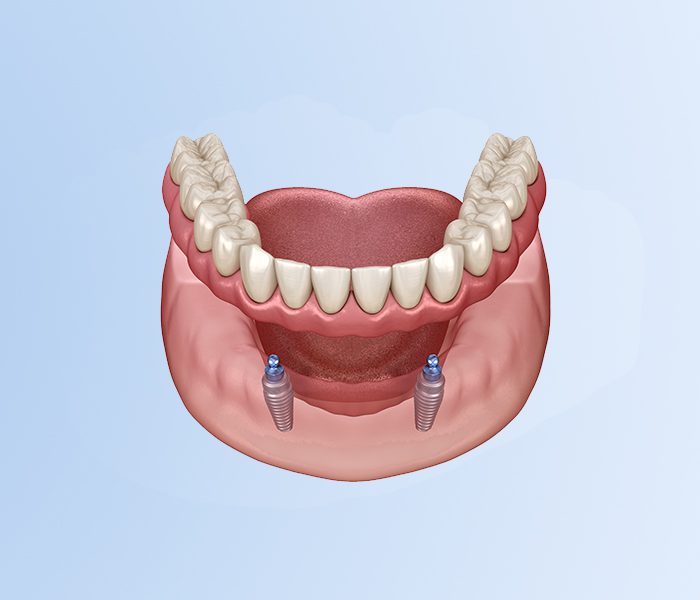
Dental implants are titanium screws that are inserted into the jawbone to assist support and fastening the dentures. Please find more information on our service page about Dental Implants.
Benefits
- More retentive and improved comfort: These dentures are more comfortable and produce less friction on the gums than standard dentures since they fit better.
- Removable: These dentures can be removed for easy daily cleaning underneath the dentures
- Improved eating capabilities: These dentures provide improved chewing abilities and greater biting pressures, allowing denture users to effortlessly eat more difficult-to-chew meals.
- Preserves your jawbone: These dentures aid in preservation of jawbone structure, preventing further bone loss and facial sagging.
- Improves your quality of life: You can enjoy socializing without worrying about the embarrassing moments you experience with loose dentures.
Overdentures are a wise investment in your enjoyment and health because they endure for decades.
Frequently Asked Questions About Implant Supported Dentures in Lower Hutt
Conventional dentures rest on the gum tissue and rely on natural suction or adhesive to stay in place, which can result in movement during eating and speaking for some patients. Implant supported dentures are anchored to titanium implant posts in the jawbone, which may provide greater stability than conventional dentures depending on the individual case. We will discuss both options with you during your consultation at Naenae Dental Clinic to help you understand which may be more appropriate for your individual needs and circumstances.
The number of implants required to support a full arch denture depends on factors such as the volume and density of your available bone and your individual treatment goals. At our Lower Hutt clinic, we use a minimum of two implants as a starting point. Additional implants may be recommended to improve stability and retention, depending on your specific circumstances. We will determine the most appropriate number of implants for your situation following a full assessment.
Transitioning from conventional dentures to implant supported dentures involves a surgical phase where the implant posts are placed into the jawbone, followed by a healing period to allow osseointegration to occur. Once the implants have integrated, the denture is then modified or replaced to attach to the implant fixtures. We will assess your current denture and bone structure during your consultation at Naenae Dental Clinic to advise on the most appropriate approach for your transition.
In most cases, a healing period is required after implant placement before the final denture is attached to allow the implants to integrate with the jawbone. During this healing period, a temporary arrangement may be provided so you are not without teeth. The specific timeline will depend on your individual healing and treatment plan. We will outline a realistic schedule for your treatment during your initial consultation in Lower Hutt.
Because implant supported dentures are removable, they can be taken out for cleaning underneath the denture and around the implant attachments. Regular cleaning of the denture itself using a soft brush and appropriate cleaning products is recommended, as is cleaning the gum and implant attachment areas. The implant fixtures and surrounding gum tissue also require attention as part of your daily oral hygiene routine. We will provide specific cleaning guidance when your implant supported dentures are fitted at Naenae Dental Clinic.
The attachments that connect the denture to the implant posts can experience wear over time and may require periodic replacement to maintain effective retention. The frequency of replacement will depend on the type of attachment system used and how well the dentures are maintained. At our Lower Hutt clinic, we will monitor the condition of the attachments during your regular check-up appointments and advise when any servicing or replacement is recommended.
Significant bone loss can affect the number of implants that can be placed and may influence the type of implant supported denture that is most appropriate. In some cases, a bone grafting procedure may be considered before implant placement to improve the available bone volume. We will assess your bone structure using imaging during your consultation at Naenae Dental Clinic and discuss the most appropriate options based on your individual clinical findings.
Following implant placement surgery, some mild discomfort, swelling, and dietary adjustments are to be expected during the initial healing period. We will provide you with detailed aftercare instructions following your procedure and advise on what foods to avoid and how to keep the surgical area clean. If you experience significant pain or swelling that does not improve after the first few days, please contact us at Naenae Dental Clinic so we can assess whether any further attention is needed.
One of the considerations associated with tooth loss is the gradual reduction of jawbone volume in the areas where teeth are missing, as the bone is no longer being stimulated by tooth roots. Dental implants act as a substitute for tooth roots and can help to provide stimulation to the surrounding bone. At our Lower Hutt clinic, we will discuss how this may be relevant to your individual situation and what it means for the long-term health of your jaw structure during your consultation.
The cost of implant supported dentures is generally higher than the cost of conventional dentures. This is because treatment involves a surgical component and additional materials. Costs vary depending on your individual circumstances, including the number of implants required and the type of denture used. There are other factors worth considering beyond the upfront cost, such as ongoing maintenance and how each option suits your needs. We will provide a personalised cost estimate following a full assessment at our Lower Hutt clinic.